
I’ve just finished season 1 of Severance, the Apple TV+ series and I must say, I’m impressed. The way it slices consciousness into ‘innie’ and ‘outie’ is a clear allegory of Marx’s concept of alienation, but for me (with my obdurate urban gegoraohy schooling) the architecture doesn’t just set the scene, it is the scene. Vast, sterile, and almost aggressively bland, the interiors of Lumon Industries’ headquarters are more than just uncanny and liminal, they are the real cathedrals of capitalist alienation, rendered in plasterboard and lino.
At first glance, the office space resembles something between a 1990s call centre, a failed airport, and the set of a corporate horror film. But with repeated visits, the spatial dissonance reveals something else: a Marxist nightmare made manifest. The architecture of Lumon HQ is a hyperreal monument to the severance of worker from work, of labour from life, and of self from self.
Karl Marx described alienation as the estrangement of people from aspects of their human nature due to living in a society stratified by class and driven by capital. Under capitalism, workers are alienated from the products of their labour, from the process of labour, from their species-being, and from each other. Under late capitalism, this alienation has infected us so deeply it’s making us all ill. Severance takes this theory and represents it with surgical precision: workers at Lumon are physically and psychologically separated from the products of their work, and even their own identities.
The architecture enforces and mirrors this severance. Empty and bafflingly long corridors stretch into oblivion, lit with sickly fluorescent lights. Like the anti-Vegas, there are few signs, no windows, and only one clock (that I noticed anyway). The effect is disorientation, but clearly not chaos. It’s an ordered disorientation, an anaesthetic maze designed to strip the employee of temporal and spatial bearings. This is alienation with an access badge.
The macrodata refinement floor, where our protagonists Mark, Helly, and the rest of the innies toil, is an open-plan void surrounded by endless white. Yet rather than fostering collaboration, its scale isolates. It is a space that negates intimacy. Four desks huddle together like islands in a blank sea, the vastness making the humans within appear absurd, even disposable. The size of the space doesn’t liberate, it ensnares them all in a constant rush to meet quotas. In this sense, Severance draws on the tradition of architectural estrangement seen in works like Jacques Tati’s brilliant 1967 film Playtime or the sterile zones of institutional modernism.
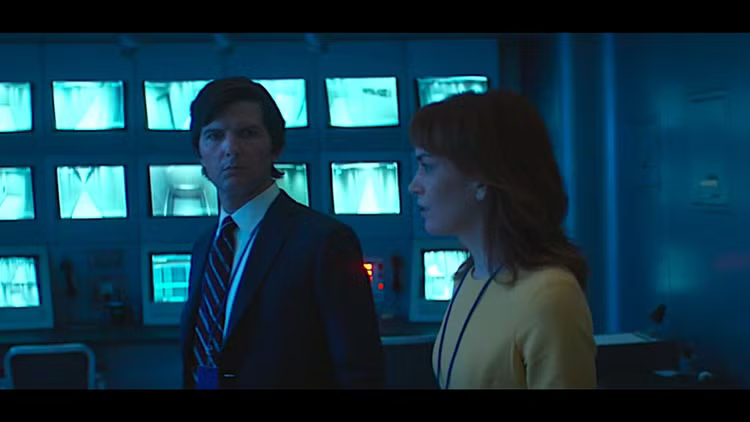
Foucault’s panopticon lurks beneath this too. Surveillance is implied, not overt. Cameras are rarely seen, but the sense of being watched by Lumon, by Kier, by some impenetrable authority is ever-present. Like the urban realm more boradly, it doesn’t need to physically confine when it psychologically encloses. This is argubly the archetypal neoliberal architecture: not brutal in form, but softly menacing in function.
Contrast this with the world of ‘outies’: the employees’ suburban homes are neat, warm-toned, although oppressive in their own way. Mark’s outie life is one of scripted grief and shallow domestic comfort. Hence, the exteriors here are not refuge but façade. In classic Marxist terms, the home becomes a site of false consciousness, a place that soothes the worker without liberating them. For the severed, the outside world offers no escape: it is simply another level of the simulation.
Lumon’s architecture, then, serves to dramatise the totality of capitalist domination. Not only is the worker alienated within the office, but even beyond its walls, there is no re-integration of self; only further division and further control. The built environment is not incidental to the alienation; it is a condition of it.
In Severance, architecture is ideology made physical. Lumon HQ is a shrine to the cult of work, where space disciplines as much as policy. The labyrinthine design, muted palette, and spatial excess are not just aesthetic choices, they are the very mechanisms of alienation. The show’s genius lies in how it spatialises Marx’s critique, rendering the abstract violence of capital under the glare of oppressive fluorescent lights.
 taCity
Leave a comment