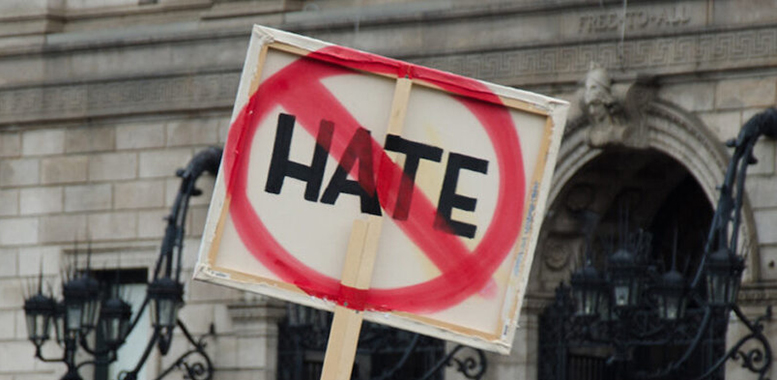
It’s easy to feel hateful at the moment isn’t it? Humanitarian flotillas are kidnapped by rogue states, fascist leaders and thug cops mercilessly beat peaceful protestors; and that’s just in the last few hours. Pretty much since I can remember, the mediascape has been full of situations and institutions that are not only sorrowful but deliberately catalysed by the powerful in a way that invites hatred towards them as if it’s their fuel. We have rage-baiters on the streets spewing hateful rhetoric with a GoPro strapped to their head so they can fill it for clicks and cash. All the whle the mainstream press (on both sides of the Atlantic) continues to publish its hate-setting agenda, instructing the apathetic masses who they should target their two-minute hate towards this month. Hate is always simmering, often spilling over. It’s in the comment threads and the campaign rallies, in news tickers and on picket signs.
But while the targets of hate may change, the raw emotion of hate isn’t new. It’s as ancient as we are. It’s psychic. It’s social. And of course I would say, it’s political. In ancient Greece, hate was already entangled with politics and judgement. Aristotle didn’t treat emotions as messy private phenomena; for him, misein (hatred) was a public thing, a kind of verdict on character and needed so that you could be reasoned with. If anger flared up over a single event, hatred was colder, more permanent. You hated someone not because they wronged you once, but because of what you believed they were. Plato, too saw emotions not as distractions from reason, but part of it. In the Republic, hatred belonged to the spirited part of the soul, that part which makes us rise up against injustice, that rages not just against personal insult, but against the order of things. But this I would argue is more akin to today’s righteous anger, not hatred. Anger is an important emotion to stir action; hatred is an underlying deeper prejudice that requires exorcism.
Philosophies of Hate
Twenty centuries later and Freudian psychoanalysis comes to the fore and within this realm hate ran deeper than politics (or perhaps was apolitical altogether). It sprang from the death drive, that murky compulsion toward aggression, undoing, dissolution, nothingness. Civilisation itself, Freud argued vehemently is a compromise: we suppress our instincts to avoid tearing each other apart. But the violence doesn’t vanish as such, it just changes clothes. It becomes guilt, cruelty, repression, and yes, hate. Our hatred is a side effect of keeping the peace, an overflow of what cannot be said, done, or desired. Bluntly put, for Freud, we hate because we are told to behave.
Look around: aren’t we still living inside this contradiction to some extent? The workplace smile, the polite nod, the “like” button on social media, meanwhile, resentment festers beneath the surface. The rage is real, but it’s redirected to perhaps destructive means (depression, violence and self-harm). Freud would, with some justification, perhaps recognise late capitalism as one of mass repression. Or worse, sublimated sadism: hatred made banal.
For many contemporary philosophical thinking (not least that of the continental philosophers that us lefty Anglophone academics have a love-hate relationship with), hatred simplifies. It gives the world clean lines: us/them, good/evil. In that way, it comforts. For Emmanual Levinas, hate begins when we turn away from the face of the Other; when we refuse to acknowledge the infinite ethical demand that every other person makes upon us simply by being. In that refusal, hatred is not just violent; it is metaphysical. It is a denial of responsibility, of relationship, of the sacred.
Then there’s everyone’s favourites, Deleuze and Guattari, whose work reads like a diagnosis of the modern subject as a machine of confused desire. For them, hatred isn’t natural, like all desires, it’s produced. The systems we live in manufacture it, cultivate it, sell it back to us. Late capitalism, stoked now by the fascists in charge, has a canny knack for turning discontent into division and vice versa. We have become people who, as D&G put it, ‘desire our own repression’. Think about it, we vote for strongmen who we know will abuse us, but we do it anyway. We fear the Other because we’re told to. We lash out at migrants, at queers, at the poor; anyone except those actually responsible for our suffering. In this way (and in a similar way to which Orwell imagined it) manufactured hate becomes part of what society is.
The Exorcism of Hate
Which brings us to today. Hate is no longer a breakdown of civility, it is civility. It is coded into algorithms, incentivised through clicks, monetised by platforms, pushed by AI. We don’t stumble into hate anymore. We’re nudged into it. Carefully. Profitably. Politically.
But what is it, really, that people hate? The immigrant? The woman speaking up? The protester blocking a road? On the surface, maybe. But beneath that, there’s something more like grief at play. A grief that doesn’t know its name. A grief at being abandoned by a system that promised comfort and delivered anxiety. That promised prosperity and gave precarity. That promised individuality and gave isolation. Hate, in this light, is a misrecognised cry for meaning. It gives the illusion of control in a world that feels increasingly ungraspable (something which Will Davies narrates excellently in his book Nervous States). It’s a coping mechanism masquerading as a worldview.
And yet, as Plato noted, not all hate is equal. There is also the kind of hate that sharpens, that clarifies, that refuses to accept violence and calls it by its name. Audre Lorde spoke eloquently about all this in regards to racial prejudices – not hate for hate’s sake, but a dignified and yes, righteous anger, transformed into solidarity. A hatred of injustice. A refusal to forget. For Lorde, and many others sympathetic to the Black radical tradition, that kind of hate is a form of love in disguise.
So perhaps the task is not to banish hate but to rewire it. To distinguish between the hate that isolates and the hate that gathers. The hate that disfigures and the hate that reveals.
The world today is totally saturated with feeling, so much so that feeling drips out of every pore, and much of it is riddled with hatred. And so such hatred is not a failure of civility, or a moral defect, or a glitch in human nature. It is a signal. A flare in the night. A clue that something is deeply, structurally wrong. And like all emotions, it demands interpretation, not condemnation. Only then can we perhaps ask a better question than ‘why is there so much hate in the world’, and rather ask a more pertinent one: what does hate want? What might it become, if we stopped feeding it fear and started feeding it truth?
 taCity
Leave a comment