In the daily doomscroll, I came across this news article that tells of how Alan Hamel, a multi-millionaire entrepreneur has been ‘keeping his wife alive’ with AI’ “you can’t tell the difference!” Grief effects people different, of course it does, and being married for 55 years, I can perhaps understand his aching urge to keep his wife ‘alive’. But I think there’s a deeper issue here that speaks to the uneasy relationship that the super-rich have with immortality, and how ‘death’ to them is simply just another limit to capital accumulation.
Extreme wealth has always sought to perpetuate itself beyond the lifespan of any individual. After all, no one person can spend all that money in one lifetime. So dynastic fortunes, family foundations, and corporate inheritance structures are the economic mechanisms by which the ruling class has long defied the biological limits of life. Passing on wealth to children has been the way to ensure a legacy after death. But in the digital age, the desire for continuity has taken a new, literal form. Silicon Valley billionaires like Peter Thiel, Larry Ellison, and Bryan Johnson have invested heavily in “longevity science” cryogenic preservation, and ‘biohacking‘ regimes that promise to slow, reverse, or even escape aging. Behind this lies not only fear of death, but an ideological conviction that the self-made, data-driven, exceptional(ly rich) individual should be exempt from the entropy that defines ordinary existence.
The fantasy of immortality is thus inseparable from class. It is not simply about extending life; it is about extending domination.
The fantasy of immortality is thus inseparable from class. It is not simply about extending life; it is about extending domination. To live forever, for these ‘elites’ is to preserve their vice-like control over capital, data, and in a warped way, the very definition of what it means to be human. Thus these outlandish billionaire immortality projects function in some way as the biotechnological counterpart to offshore tax havens: both are mechanisms to insulate wealth and power from the natural processes of decay, redistribution, and change.
Artificial intelligence, particularly in its generative and mimetic forms that Alan Hamel has used (but he is not the only one), has deepened this fantasy. The rise of ‘grief tech‘ — AI systems that reconstruct the personalities of deceased individuals using their digital traces — offers an uncanny form of digital ‘resurrection’. When 17-year-old Joaquin Oliver, a victim of a mass school shooting, was ‘recreated’ (I’m not using ‘resurrected’ deliberately because that’s not what’s happening here) to be interviewed by a journalist, Pandora’s Box of the undead had been well and truly opened.
While marketed as therapeutic (and as an macabre offshot of wellness capitalism), this technology enters into a more nefarious realm of capitalist extraction, or as Marx would have said, primitive accumulation. These ghoulish AIs transforms the dead into data, making memory itself a new frontier of rampant commodification. The self becomes something that can be preserved, owned, and even licensed; a dataset rather than a life.
For the billionaire class – their extreme wealth having ripped them out of any sense of human community and commonality – this capacity to reproduce consciousness resonates with their own obsession for their grip on capital to outlive the vulnerability of human flesh. When an AI can emulate your speech, gestures, and decision-making patterns, you are, in a sense, already immortal, not as a spirit, but as software. This ‘data immortality’ fuses seamlessly with the transhumanist ideology of Silicon Valley, where the body is seen as an obsolete vessel and the mind as an information system awaiting upload. In this worldview, the human subject – particularly the white, male, entrepreneurial subject – becomes the subject to be endlessly replicated digitally at the expense of Other forms of unworthy identity.
Reading Jordan S. Caroll’s brilliant pamphlet ‘Speculative Whiteness‘, it becomes clear that the alt-right, and fascism more broadly, see the future as something they own. Black and brown bodies are simply unworthy of life, and so the goal is to produce a society – and entire world – in which deviant forms of subjectivity simply do not exist anymore. So it is easy to see why, for fascists, AI is a tool to achieve this because it can be used to preserve Whiteness into the future in perpetuity: particuarly if the means of AI production is owned by white supremacists.
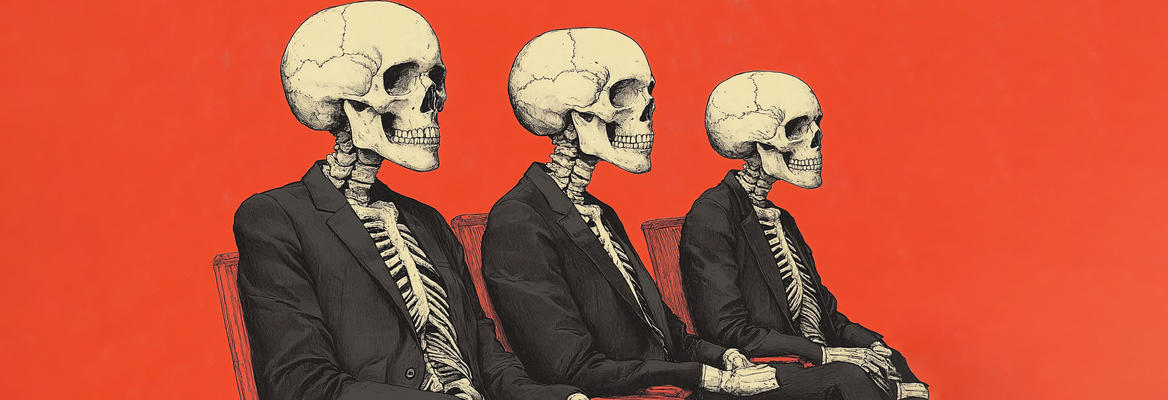
We need a right to stay dead. Death, in its inevitability, is what binds all beings together. It is our root back to the Earth.
At the heart of all this lies what philosopher Ernest Becker called ‘the denial of death‘. Capitalism, as we know, is a system that must grow infinitely and thus cannot accept the finitude that defines life. The super-rich have come to embody this denial materially. But also as we know, this denial has consequences. The more these morid paragons of capital tries to escape death, the more it produces forms of death elsewhere; ecological destruction, social dispossession, colonialism, the list goes on. The same AI systems that simulate the voices and faces of the dead also automate mass layoffs, fuel misinformation, and intensify surveillance. The dream of infinite life for the elite thus rests on the necropolitical production of premature death for many others.
What is to be done? To confront this confluence of sickening wealth, technology, and white supremacist fascism, we must reclaim mortality as a site of equality. We need a right to stay dead. Death, in its inevitability, is what binds all beings together. It is our root back to the Earth. Even the burying of bodies in synthetics, shrouds, and boxes riddled with forever chemicals puts a unnatural barrier between the materiality of our dead bodies, and the materiality of Mother Earth from which is was made from and should go back to.
To be mortal is to be part of the world, to depend on others, and to be responsible for the future we will not see. The billionaire project of immortality, whether that’s through biology, AI, or the colonization of space, is hence the ultimate anti-democratic fantasy. It seeks to essentially privatize the future, to make even death itself a frontier of profit.
A truly humane technological politics would begin from the entirely opposite premise: that technology should help us live well with our limits, not deny them. To empower a regenerative politics and materiality (something which, incidentally, solarpunk is all about). Instead of resurrecting the dead through AI, we might use digital tools to preserve collective memory and repair historical injustice. Instead of pursuing individual immortality, we might build infrastructures of care that ensure collective survival. And instead of worshipping the godlike innovators of Silicon Valley, we might learn from the humility of ecosystems that thrive through interdependence, decay, and renewal.
 taCity
Leave a comment