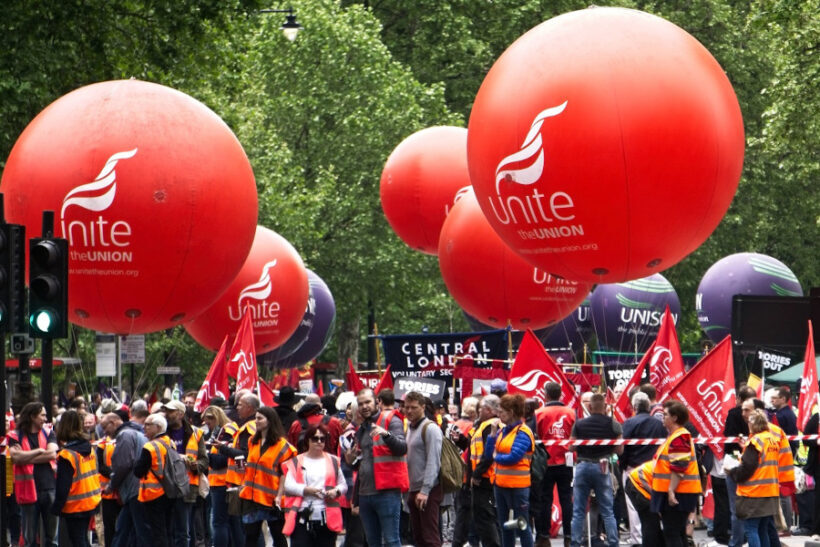
There’s been a lot of talk about a General Strike, but what exactly does that mean? And why are they important?
Well ‘generally’ it would entail as many unions as possible – but consisting largely of the public sector – to go out on strike collectively. Yesterday saw teachers, university workers, civil servants, train and bus drivers all out on strike in one of the largest strike actions certainly in my lifetime.
Historically though, you can trace the idea back to a political activist and general rabble rouser called William Benbow – he argued for a ‘national holiday’ as a means to let the working classes get involved in running the country.
The first proper general strike occurred then in the England in 1842, and arguably, also when slaves staged a mass walkout of the plantations during the American Civil War (although this is not in the context of ‘unions’, given the complete lack of any rights afforded to slaves).
But perhaps the biggest – certainly in terms of people involved and ability to bring a country to a halt – was in France in May 1968, when over 11 million people took to the streets resulting in the collapse of the government of the time.
History has seen many general strikes, but the more recent of them – because of the prevailing governmental forces of the day being incredibly anti-union and very, very neoliberal – have been quashed before they can begin.
But in 2023 in the UK, the ‘working class is back’ according to Mick Lynch. However, trade union membership is only really starting to creep back up after years of decline, so it’s a bold statement. But because of the very extreme binary nature of the political landscape, it’s easy to see why Mr Lynch is proclaiming this. It is not secret that the Tory government has for 10 years or more, slowly driven down wages, eroded union power, enriched the elite and generally made life worse for those people who earn the least; with some calling it the ‘lost decade‘. The current – and completely avoidable – cost of living crisis is simply turbo-charging the extreme income and wealth inequality that exists in the UK.
Furthermore, the very strict union busting laws has made union leadership to even more focused on acting strategically. Individual unions are talking to each other, co-ordinating action, sharing tactics and basically doing all the things that are characteristic of general strike planning.
There isn’t really a threshold of numbers for a general strike, but if there is co-ordinated action by key workers – not just those currently on strike, but more of them – then we can say that were in general strike territory.
Why is a general strike important?
Striking is really, the only legal action left to those people looking to effect a positive change in their working conditions.
Striking has been a legal right for centuries, but slowly over time – but more rapidly recently – it has been eroded. As we speak, the UK parliament is trying to pass a bill that will make striking illegal for many people in the public sector. If this bill passes – it will be catastrophic for workers and their families.
So co-ordinated union action that targets the everyday public infrastructure of the country makes a huge statement. When the nurses go on strike, its massively inconvenient for people in need of health care, but if, at the same time, people couldn’t get around the country, were unable to get into work, if our school children couldn’t go to school because the teachers were on strike, and there were no ambulances, fire fighters, legal workers, civil servants and so on and so on – the country would grind to a halt. Businesses would suffer, as would anyone trying to get anywhere.
But that’s the point. Striking is deliberately disruptive to show the government and the elite that the workers are the ones that do the work; they are ones whose labour is extracted in order to make profit, share value and dividends. Quite simply, as Marx said all those years ago, the rich simply get rich off the backs of the blood, sweat and tears of the workers. A general strike brings this unjust relationship into very sharp focus: the hope is that everyone understands that and demands real change.
So with a general strike – it shows the government that they serve us, not the other way round.
But it’s the last option the workers have. If it becomes illegal or the billionaire-owned press continue to smear the unions and gullible right wing press readers and viewers lap it up, then the next step is a full-on riot. And nobody wants that, just ask those who suffered through the Poll Tax riots.
A general strike therefore is the last, but the most effective weapon of the oppressed. So get prepared, get mobilising, because 2023 undoubtedly, will the year of the general strike.


Leave a comment